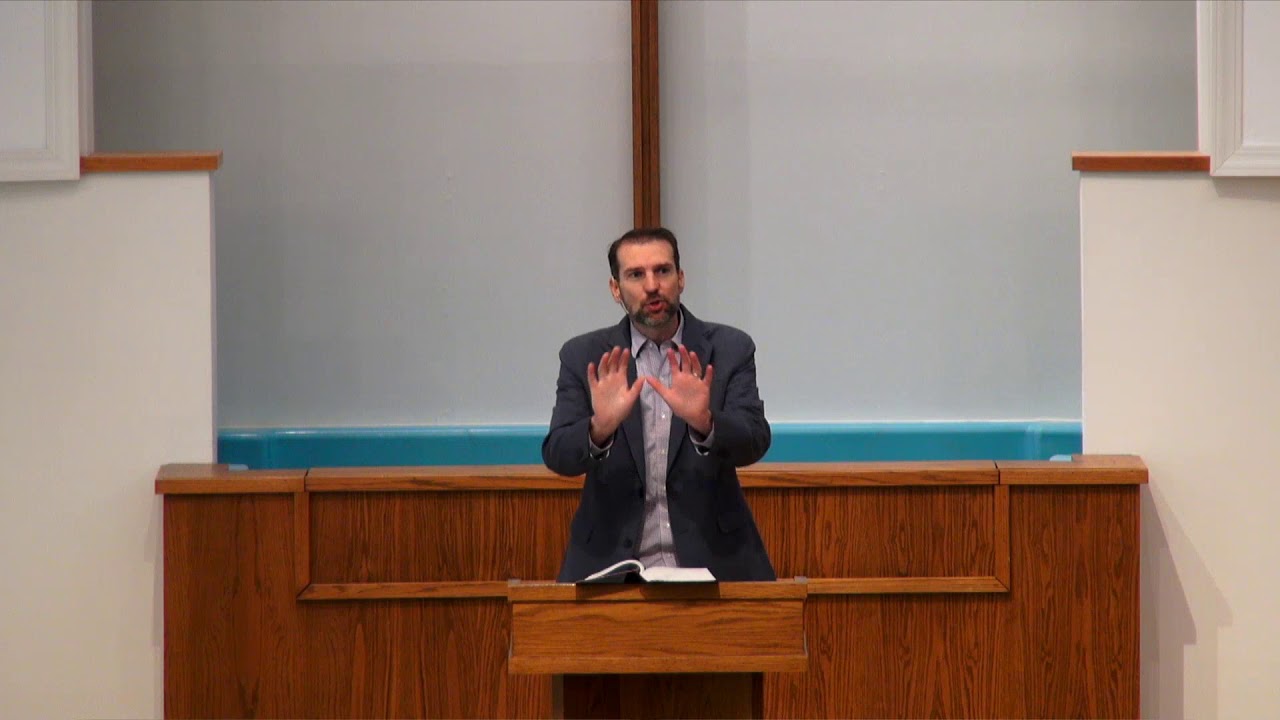
I sure didn’t expect to be preaching this sixth message in our series through Acts to an empty sanctuary on a day when, in love for our neighbors, we are sitting at home. But it is comforting to know that the Lord did indeed know this and had written this day down in his book—according to Psalm 139—before any of us had been born. And actually this text feels like a providential gift as I’ve reflected on it more and more because I didn’t just look at the events going on in this odd time and think, “Hey, you know what text would work well? Acts 8!” Rather, I mapped out the book of Acts, decided seventeen messages was the way to go, mapped out a preaching schedule on the sermon card, and this has all brought us to this moment of looking at Acts 8. And yet, if I had chosen a text for today in light of all the events going on, I may well have chosen Acts 8.
The reason why is because the setting of Acts 8 is similar to ours in this sense. The early church had to have felt in a moment that life as they once knew it had been utterly overhauled, and they had no idea what the future was going to look like. Let me explain. After Stephen’s death by stoning, chapter 8 begins, “And there arose on that day [i.e. the day of Stephen’s martyrdom] a great persecution against the church in Jerusalem, and they were all scattered throughout the regions of Judea and Samaria, except the apostles. . . . [And] Saul was ravaging the church, and entering house after house, he dragged off men and women and committed them to prison” (8:1, 3).
Think about all the sense of upheaval and unknowns and anxiety. Stephen has been killed. Persecution is breaking out all over Jerusalem. People are scattering, while the apostles are staying. What’s going to happen? Will the church rebound? How will the church survive being separated from the apostles who remained in Jerusalem? Is this work going to die out? Will everyone be imprisoned or killed? Our questions are different than these in numerous ways, but similar in others. So what then does this text teach us in a setting where it seemed like everything was thrown into upheaval and unrest, the future looked hazy at best, and questions and anxiety could have abounded? It teaches us two things: 1) God is always at work in carrying out his mission, and 2) the church’s mission isn’t altered by unrest and upheaval in the world. Let me start with the first of these points.
You’ll remember that Jesus told the church in Acts 1:8, “You will be my witnesses in Jerusalem and in all Judea and Samaria, and to the end of the earth.” And in terms of being witnesses of Christ in Jerusalem, things were going stunningly well. In 5:28, the Jewish religious leaders had noted that the church had “filled Jerusalem with [their] teaching,” even after they’d been threatened. And right before Stephen’s death, Luke had noted that “the word of God continued to increase, and the number of the disciples multiplied greatly in Jerusalem, and a great many of the priests became obedient to the faith” (6:7).
But as far as Judea, Samaria, and the ends of the earth, we just don’t have anything to report in these first seven chapters of Acts. And then we read the events of Acts 8:1—persecution, unrest, scattering, and potential for all kinds of anxiety. But look what happens next. Luke writes in verse 4, “Now those who were scattered went about preaching the word.” That is, after bearing witness to the Lord in Jerusalem, filling Jerusalem with teaching about the Lord, and seeing disciples multiplied greatly in Jerusalem, they are scattered to Judea and Samaria where they go about preaching the word. They were bearing witness concerning the crucified and resurrected Lord Jesus in Judea and Samaria, just as the Lord had commanded them days earlier.
In other words, the Lord utilized this persecution—which the enemy intended to destroy the church—as a means to move his church to greater obedience. He moved them out of the confines of Jerusalem into Judea and Samaria so that they might bear witness concerning Jesus there and fill those areas with his disciples as well. Do you see what’s going on? The world feels like it’s in utter disarray, and the Lord is simply moving his people to get them in place to be witnesses in Judea and Samaria just like he’d commanded them in Acts 1:8.
And it would be one thing if Acts 1:8 and 8:1 were some kind of exceptional and rare combination in the Scripture. But it’s not. The Lord always fulfills his purposes and is always working to fulfill his purposes in every moment—even those moments when everything from our perspective feels like it’s spiraling out of control. He’ll take a young man in Joseph—who from the moment his brothers sold him into slavery had to feel like things were going about as badly as possible—and make him the second in charge in Egypt in order to save the Israelites during famine. And on and on and on we could go. So know this: this moment is no different. The Lord is working right now in ways we may not see clearly to fulfill his purposes and plans. This is not a time to be shaken by things outside of our control but to rest in the one who has all things in his control. And second, we see:
What’s so striking about the way that Luke writes this is that he writes it as if it is so obvious that the church would have kept on doing what Jesus had told them to do. And they did. Like them, we live in a time of great upheaval and unrest. In our situation it’s not persecution but a virus, but there’s great upheaval and unrest nonetheless. But what we are reminded of in this chapter is that the church’s mission wasn’t altered simply because of upheaval and unrest. The church was focused on the commission Christ had given to them, and we see this through their—and especially Phillip’s—obedience.
Let’s notice a few things about their (and his) obedience to the Lord:
In other words, it didn’t seem like Phillip was saying, “I think I’ll just sit back until things cool down.” Rather, he was saying, so it seems, “I guess I’ll just evangelize in this setting, then because that’s what Jesus told us to do.” It’s simply stated in verse 4: “Now those who were scattered went about preaching the word.” And when you see the word “preaching” there, you don’t need to think like what I’m doing behind the pulpit with the gathered church on a Sunday morning. You need to think evangelizing. They’re simply proclaiming the gospel to people as they go. They happened to be scattered in Samaria, and so they are evangelizing in Samaria.
I know that right now isn’t an ideal time in our lives in so many way. We can’t get out and gather with people. Much of our conversation is over the phone or internet. We feel very isolated. But we also have a time when many people are thinking about their frailty and the reality of death. And we can walk with hope—not because we think we won’t get sick or are inevitable to death—but because we know that for us death is not the last word. And so we have the opportunity to speak to others—over the phone or internet or more than six feet away from them in groups smaller than ten!—about the reason for the hope that is in us at a time when they may be ready to listen. So, let’s take evangelistic opportunities wherever we find them. It may be able to be written one day: “On that day a virus broke out all across the globe, many were panicked and asking questions, and believers proclaimed the Word of God to them.” Let’s look for and take advantage of evangelistic opportunities wherever we are. Next:
From the point of 8:5 to the end of the chapter, Luke focuses us on the evangelism of Phillip specifically. Phillip was one of the seven deacons chosen to oversee the distribution of food to all the widows in the church. But Luke obviously wants us to see that this wasn’t all that deacons did. They proclaimed the Word of God to people as well, which we saw with Stephen in chapter 7 and we see with Phillip in our text this morning.
And as Phillip leaves Jerusalem in the midst of persecution there, he goes to Samaria and begins evangelizing the Samaritans. Luke writes in verse 5, “Phillip went down to the city of Samaria and proclaimed to them the Christ.” Now, we could read this and think, “Well, that’s nice. He just went to a city in Samaria and evangelized, just like you or I might go to Kentucky or Mississippi and evangelize.” But it’s not quite the same thing.
You see, the Samaritans and Jews weren’t a group that got along with each other. When the kingdom of Israel divided in the tenth century BC, it divided between the ten northern tribes and the two southern tribes. The two southern tribes included Judah and Benjamin and was known as Judah, and the ten northern tribes made up the northern kingdom and was known as Israel. Well, the northern kingdom of Israel made Samaria their capital. Then, in 722 BC the Assyrians came in and conquered that northern kingdom, and they took away many inhabitants, but they also populated the area of Samaria as well with non-Jews who eventually married and bore children with the remaining inhabitants. This means that the Samaritans were half Jewish and half non-Jewish. The Jews in Jerusalem then referred to them as “half-breeds.”
And the division between the Jews and Samaritans got even worse after the southern kingdom of Judah was conquered by the Babylonians, taken into exile, and then released to go back to build the temple in Jerusalem. When the Jews came back to rebuild the temple, the Samaritans wanted to help, but the Jews wouldn’t let them. So the Samaritans eventually built their own temple on Mount Gerazim. Consequently, the Samaritans were despised by the Jews because of their half-breed race as well as their heretical religion, for the Lord had made clear that Jerusalem alone was where the temple should dwell. Needless to say, this division was quite a nasty one.
Therefore, when the text tells us that Phillip went to Samaria and proclaimed to them the Christ, we need to understand that he is going to a people whom he probably had been taught to avoid and think little of. But he goes and preaches the gospel to them nonetheless. And we read, “When they believed Philip as he preached the good news about the kingdom of God and the name of Jesus Christ, they were baptized, both men and women” (v. 12).
Now, one interesting thing that happens is that the Samaritans don’t receive the Spirit the moment they believe. We read in verses 14-18, “Now when the apostles at Jerusalem heard that Samaria had received the word of God, they sent to them Peter and John, who came down and prayed for them that they might receive the Holy Spirit, for he had not yet fallen on any of them, but they had only been baptized in the name of the Lord Jesus. Then they laid their hands on them and they received the Holy Spirit.” Why is this the case?
I think the answer lies in the identity of the Samaritans and this divide that had existed between the Jews and the Samaritans. In other words, I think this delay of receiving the Spirit was God’s means of validating the Samaritans as genuine believers, just like the Jews who believed on the day of Pentecost. You see, if they had received the Spirit when they believed under the preaching of Phillip, perhaps there could have been an idea that maybe they were second-tier Christians or quasi-Christians, just as they’d been thought of as half-bred Jews. Well, now that the apostles themselves come and lay hands on them and they receive the Spirit, there is simply no questioning. They’re believers just like those Jews who believed and received the Spirit on the day of Pentecost. The Lord was making sure to validate them with the laying on of hands by the apostles.
But it’s not only the Samaritans that Phillip evangelized but also an Ethiopian eunuch. Luke tells us that “and angel of the Lord said to Philip, ‘Rise and go toward the south to the road that goes down from Jerusalem to Gaza” (v. 26), and he did, and one he got there he saw an Ethiopian eunuch, who was such a high-ranking official that he was in charge of all the queen’s treasure. And he happened to be reading the scroll of Isaiah.
He’s reading Isaiah 53, which tells us—700 years before Christ’s coming—of Jesus dying for our sins, and Philip asks him if he understands what he’s reading. The man responds, “How can I unless someone guides me?” (v. 31), and then Phillip proceeded to tell him the gospel, and the man believed and was baptized after they came upon some water.
But the main thing I want us to see here are the unlikely targets for evangelism. First, you have the Samaritans, and yet Phillip takes the gospel to them, and they believe. Then, you have an Ethiopian eunuch, which would have meant that he’d had been castrated, and he was a high-ranking official. Again, Phillip could have thought he had no means of relating to this guy. Phillip wasn’t an Ethiopian, and we have no reason to think he’d been some high-ranking official. Moreover, the fact that this man was a eunuch may have made him somewhat of an outcast in society, and yet Phillip preaches to him, he believes, and he becomes part of the church.
Brothers and sisters, are their individuals whom you don’t even think of as evangelistic targets because of differences of race, class, culture, or because you’ve been taught to think of them as enemies? God forbid. One of my prayers for us in this time when the sexual revelation is sweeping through our culture and individuals are undergoing “therapy” in an attempt to change genders, is that we would see them as Phillip saw the Ethiopian eunuch—as someone who needs the gospel, and we’d preach to them, they’d believe and be baptized, and we’d bring them into our church and teach them to obey all that Christ commands. May we never be found neglecting taking the gospel to anyone for any reason or forgetting that everyone outside of Christ is in need of him—just like we were.
I also want us to see that their evangelism produced varying results.
It goes without saying that Phillip saw great fruit in his evangelism. We’ve already noted that the Samaritans were believing so that Luke tells us “they were baptized, both men and women” (v. 12), which is a perfect balance to his note that Saul was ravaging the church, dragging off “men and women” (v. 3). Paul is persecuting, Phillip is preaching, and people are being saved. But then we have this odd picture of Simon.
Simon is one of those in Samaria who was an unlikely target for the gospel, you might say. He was a man who had demonstrated great power and amazed people with his magic. Perhaps there was demonic power at work within him. And as Phillip preached and people believed, we read, “Even Simon himself believed, and after being baptized he continued with Philip” (v. 13). However, once Peter and John came down and prayed and people received the Spirit, Simon saw this and offered Peter and John money to have that same power, saying, “Give me this power also, so that anyone on whom I lay my hands may receive the Holy Spirit” (v. 19). And Peter responded, “May your silver perish with you, because you though you could obtain the gift of God with money! You have neither part nor lot in this matter for your heart is not right before God. Repent, therefore, of this wickedness of yours, and pray to the Lord that, if possible, the intent of your heart may be forgiven you. For I see that you are in the gall of bitterness and in the bond of iniquity” (vv. 20-23). And Simon responds, not by obeying and praying but in simply asking Peter to pray that he does not suffer as Peter has stated.
Now, here’s the point, it’s nearly impossible to read Peter’s response and think that Simon is a believer. I mean, Peter says, “You heart is not right before God.” But, we might say, the text says that even Simon believed and was baptized. And my response is simply to note that the Bible doesn’t always differentiate between “believing” and “professing to believe.” It just doesn’t. If someone professes faith, the biblical authors treat someone as a believer until they show they aren’t, and then it identifies them as such. This is why, for example, Paul can say to the Corinthians in 1 Corinthians 15:1-2, “Now I would remind you, brothers, of the gospel I preached to you, which you received, in which you stand, and by which you are being saved, if you hold fast to the word I preached to you—unless you believed in vain.”
Now, wait, we might say, “Believed in vain?” I think this is simply Paul noting that the Corinthians have professed faith, and he is therefore treating them as professing believers, but if they don’t persevere in the faith, they’ll show that their profession was simply inaccurate. They didn’t have saving faith, and the reason is because saving faith is always persevering faith. Simon, in this text, professed to have faith, and they treated him as a believer, even baptizing him. But when he showed that he was bearing fruit of not truly having faith, he showed his faith wasn’t genuine. This is what James is talking about when he speaks of a faith that doesn’t bear the fruit of works and is simply dead faith.
And what this text teaches us is that our evangelism will have varying results. There will be those who reject the gospel, those who accept it and show themselves to be believers, and there may be those who profess faith, are baptized, walk with us for a while, and eventually show themselves not to know the Lord. And if that happens—as painful as it is—it doesn’t mean that we’ve done something wrong or preached the gospel incorrectly. It doesn’t even mean we shouldn’t have baptized them. Simon himself was baptized. What it means is that we will need to exercise church discipline and remove this individual from the church, declaring publicly what he is declaring with his life—that he does not give evidence of knowing Christ. Evangelism will produce varying results.
Finally, let me provide one more closing note:
This last episode of evangelism we see in this text is Philip with the Ethiopian. And it is miraculous. The Spirit tells Phillip exactly where to go. The Ethiopian happens to be reading one of the most perfect OT texts to explain the work of Christ. And then the Spirit just carries Philip to another place so he can keep on evangelizing. And you might say, “Well, if evangelism were like that, we’d all do it more often.” But do we realize that we have the same Spirit that directed Phillip and have the Word of God that is powerful to open people’s eyes to the glory of Christ?
The early church was not in a more powerful position to see disciples made across the globe than we are. In fact, we’re privileged to be able to pick up our phones, send a text or email, or get into a Facetime conversation and provide a reason to a scared world full of upheaval and unrest a reason for the hope that is in us.
Let us, during this time of craziness that hasn’t been known in over 100 years in our world be a time when believers reminded themselves that God is always working to fulfill his purpose and set about—as we were isolating ourselves physically in love for neighbor—also found themselves reaching out with our phones or computers or the like to individuals with the news of Christ’s death and resurrection so that they too might have hope, even in a time that can feel so hopeless. A few weeks ago as we looked at the believers being repeated filled with the Spirit in Acts 4, I asked us to pray for revival. I want to ask for that against this morning. May the history books speak of how believers in this time not only trusted in the one who sent his Son to live, die, and be raised for us but spoke of him to others as well so that a great awakening occurred in our nation. Amen.
SeriesActs