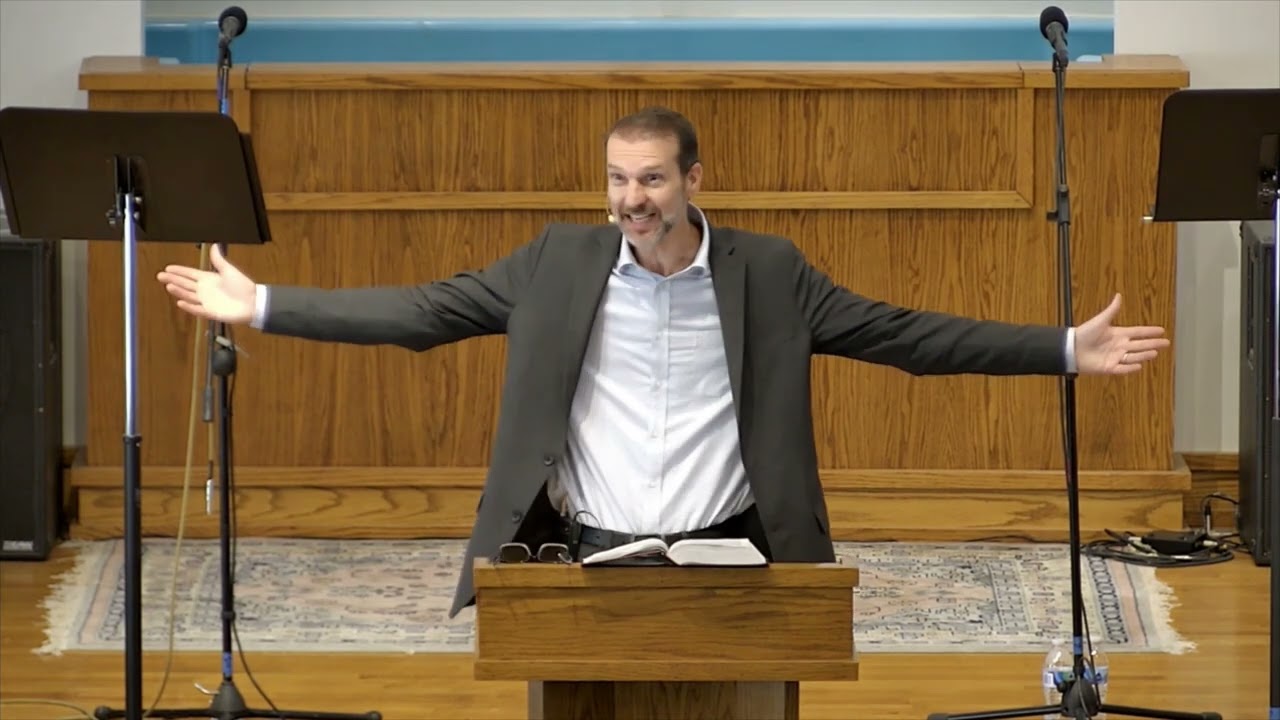
Any time I’ve preached this text or any text on the topic of marriage, I’ve noted how difficult and challenging it is to me. And today is no exception. So let me—once more—note what makes preaching on marriage so challenging. There are all kinds of reasons it’s difficult, but the main one I have in mind is its difficulty pastorally. I’ve walked with you all long enough to know that there are so many of us in different and unique and situations. There are some who have been married for years, happily. There are others who are newlyweds. There are others who are married to an unbelieving spouse and suffering greatly. There are others who are married to an unbelieving spouse and doing well, relatively, but desperately praying that your spouse would come to Christ. There are some who are single and quite content while others are single and desperately wish they were married. There are some who have been widowed and still others who have suffered through divorce or have been divorced and are now remarried. And that list might not account for everyone’s specific place in life in regards to marriage, though I tried to be as exhaustive as I could.
And so pastorally I’d like to address each and every situation that I know each of you is facing, but I simply can’t. I’d like to be able to say, “In your specific situation, here’s what I want to say to you,” but this setting just doesn’t allow that. What I have done though is given myself two weeks to focus on this text in hopes of giving myself a little more time to speak to some specific issues. But, again, there is simply no way you can address every situation when preaching on marriage. So I want to acknowledge that up front and note that this pains me as a pastor.
But, as I’ve noted, I have set aside two weeks to focus on this text. I decided to do that right before I printed out this sermon card, listening to the book of Ephesians while I was mowing the lawn. As I listened to the section we’re looking at today—5:22-33—I hit pause and began thinking about some of the areas that I needed to address, and as I began noting these, I thought, “Man, that’s going to be a lot to cover in one sermon.” And then I thought, “There’s no reason this has to be just one sermon. I’m the one who puts together the sermon card.” And that’s what brings us to today as we’re going to consider the nature of marriage in two parts, looking at this text this morning as well as next Sunday.
Let me start by noting how the text is structured and then I’ll show you how I want to approach these next two weeks. At the end of the text that we looked at two weeks ago, Paul ended that section, writing in 5:21, “submitting to one another out of reverence for Christ.” He’d written this to show what the fruit of being filled with the Holy Spirit looked like. And this was the last characteristic that he’d mentioned. But really verse 21 becomes a heading for what Paul wants to talk about in 5:22-6:9. In other words, if we read verse 21 and ask, “Paul, what do you mean by submitting to one another?" he answers in 5:22-6:9 as he speaks of wives to husbands, children to parents, and slaves to masters. In fact, the word “submit” isn’t even in 5:22, but the ESV rightly supplies it in our English translation because they understand it to be Paul’s first application of 5:21. Submit to one another out of reverence for Christ. In what way? Well, wives to your own husbands, as to the Lord, Paul answers. And he goes from there.
Therefore, here’s how I want to work through this text over the next two weeks, Lord-willing. I want to start out by noting the theological design and purpose for marriage. Then, we’ll see that this design and purpose creates roles and responsibilities for husbands and wives, respectively. At that point, I want to take some time to lay out each of these roles and responsibilities, starting with husbands and then moving on to wives. So, with that laid out, let’s start with the note that marriage has an intentional, divine design and purpose.
I want to show this by starting near the end of our text. After laying out roles and responsibilities for husbands and wives, in verse 31 Paul quotes from Genesis 2:24, writing, “Therefore a man shall leave his father and mother and hold fast to his wife, and the two shall become one flesh.” When the Lord said this, he was instituting marriage. You probably remember the scene from Genesis 2. God had Adam name the animals, and as he did so he found that there was no helper fit for him.
Now, I honestly don’t know how Adam’s mind arrived at that conclusion, but in my own mind, this could have gone two ways. It could be that as Adam named the animals, he simply recognized that these creatures were much different from him. It’s not that hard to look at giraffes, gorillas, and wolves and realize that they’re a good bit different from humans. Therefore, Adam concluded that there was no helper quite fit for him. Or, as he was naming the animals, it may be that he realized that these animals were divided into two sexes. There were bulls and cows, bucks and does, and—well I can’t remember all the different names for the different kinds of male and female animals—so we’ll just say male giraffes and female giraffes, male lions and female lions, and so on and so forth. And he may have looked at himself and thought, “There’s just one of me—a male human. I have no helper fit for me.” I tend to think this latter one was probably right.
Therefore, God puts Adam to sleep, takes a rib from his side, and forms a woman. Now, Adam has a helper fit for him. And his response makes good sense in light of what he’d seen in the animal world as God brings the woman to him and he exclaims, “This at last is bone of my bones and flesh of my flesh; she shall be called Woman, because she was taken out of Man” (Gen 2:23). And it is at this very point that the Lord brings them together in marriage—establishing a paradigm for every marriage that would take place thereafter—saying, “Therefore a man shall leave his father and mother and hold fast to his wife, and they shall become one flesh.” Again, with these words God was instituting marriage.
So Paul quotes the Lord instituting marriage in verse 31 and then says in verse 32, “This mystery is profound, and I am saying that it refers to Christ and the church.” When Paul uses the word “mystery” in Ephesians—which we’ve already seen in chapter 3—he’s using it not precisely like we use the term. We use it to mean something that doesn’t make sense or something that is perplexing enough that we can’t put the pieces all together. But when Paul uses the term “mystery” in this book, he is referring to something that was always true but was somewhat clouded until the coming of Christ, and then it became clear.
That’s what Paul is saying about marriage in verse 32. From the very moment God instituted marriage, Paul is telling us, it always was meant to refer to Christ and the church. It was always meant to show forth that glorious and intimate relationship of the redeeming Lord and his people. But that’s cloudy enough in the Old Testament that you can miss it. It’s there (and you can probably think of texts right now that show it), but it’s a little cloudy. But when Jesus comes and lays down his life for his people and rises from the grave so that they might be purified and taken as his own to join him in the great coming wedding feast, it becomes clear. That’s what Paul is saying, “This mystery is profound, and I am saying that it [i.e. marriage] refers to Christ and the church.” Marriage is God’s provided picture to show forth the glories of Christ’s relationship with his church in this world. That’s why we can say that marriage has an intentional, divine design and purpose.
Now, because marriage has this intentional, divine design and purpose, the man and the woman who enter marriage as a husband and wife take on specific roles and responsibilities. The husband is charged with picturing Christ in the relationship of Christ and his church, and the wife is charged with picturing the church in that relationship. This means that the husband and wife have distinct and particular roles and responsibilities in marriage. They’re not arbitrary. The Lord doesn’t say, “There’s a lot that goes into this marriage relationship, so figure out which one of you will do what.” No, he designed men to enter marriage and serve a particular role and for women to enter marriage and serve a particular role distinct from their husbands.
And, though I hope to make this clear throughout as I walk through the particular roles and responsibilities that fall to the husband and wife, respectively, I want to explicitly state that though husbands and wives have distinct roles from one another in marriage, their distinct roles do not mean that either is inferior or superior, more or less valuable. Both are made in God’s image, both are co-heirs of the world to come, and both are essential if indeed our marriages are going to properly picture the relationship of Christ and his church. This is the thing I may hate most about the feminist movement. The motto of that movement is that if women are going to be considered valuable, then they must do what a man does. I hate that and see it as a lie from the pit of hell. In order to be valuable, a woman does not have to fill the role of a man; she simply fills the role that the Lord has designed for her. Though each have different roles, the man and the woman is valuable as man and woman.
So, with that said, let’s start with husbands. Though it is true that Paul starts with wives in the text, I’ve already started at the end of our text anyway, so I figure I’ll just keep that trend going and start with the role and responsibilities of the husband (which Paul spends more time on as well). We can sum it up simply by saying that the husband is to picture Christ’s leadership and love for his church.
After beginning with a note to wives to submit to their husbands (which we’ll talk about next week), Paul writes in verse 23, “For the husband is the head of the wife even as Christ is the head of the church, his body, and is himself its Savior.” Notice here that Paul doesn’t say that the husband should be the head of the wife. He says that the husband is the head of the wife. In other words, men, you may be a good and godly head of your home or a bad and sinful one, but you are the head of your wife. You cannot escape this.
It wasn’t by mistake that the Lord made the man first and then created the woman. Paul will bring up this order of creation of the man and woman again in 1 Timothy 2:13, as he notes the specific and distinct roles that men and women have in the church. The man is created first and then the Lord brings the woman to his side, calling her to be his helper. He is the head and she is to be his helper.
This reality that the husband is the head of his wife implies leadership in the home. In fact, when Paul speaks of qualifications for men being pastors, he mentions that the man must “manage his own household well” (1 Tim 3:4). The man is the head of his wife, managing his home, again, just as Christ is the head of the church, his body (v. 23). But before we dive into what this should look like, let me tell you two ways that men can handle this role as head poorly and sinfully.
First, you can handle this role poorly and sinfully by trying to rule your home harshly and not allowing your wife to be your helper. This would obviously include the man who is physically abusing his wife, but don’t deceive yourself into thinking that this is the only way that we can wrongly lord over our wives. This also includes the man who leads his home in a harsh and overbearing tone. He feels his responsibility in the home is merely to give orders to his wife and inform his wife of what will be done. If he wants his wife’s opinion, he’ll give it to her.
This is both sinful and foolish. Let me start with the sinful nature of it. Colossians 3:19 explicitly says, “Husbands, love your wives, and do not be harsh with them.” Also, In 1 Peter 3:7, Peter writes, “Likewise, husbands, live with your wives in an understanding way, showing honor to the woman as the weaker vessel, since they are heirs with you of the grace of life, so that your prayers may not be hindered.” If we don’t honor our wives as they deserve, living with them in light of what God demands of us, then the Lord threatens that he will not hear or answer our prayers. Men, it is very dangerous to make yourself head of one of God’s daughters and treat her harshly and oppressively as if she is your slave. That is sinful, and you need to fear God.
But it’s also foolish to think that headship means simply barking orders at your wife. It’s foolish because she’s given to you as your helper. To think that leading your home means simply barking orders and ignoring your wife’s heart is to ignore the good gift God has given to help you. More than once over my marriage I’ve come home and shared with Lili an idea that I thought would be met with praise and thanksgiving that she’s married to such a godly and brilliant man only for her to say, “Hmmm. That is a good idea, but have you also considered this?” And I’ve altered my brilliant plan. I married an amazing helper.
So that’s one way we can get headship wrong, men, but there is an equal and opposite sinful error we can make, and this one can be equally dangerous though it’s much less noticeable in the community. This is the error of being nice and passive. By this I don’t mean a husband who is kind. We all better be kind. I mean the man who never wants to unsettle the waters. He is simply nice and passive. If his wife were to suggest that they leave a church that upholds the Bible to go to a church where the kids like the gimmicks employed there, this husband says, “Okay, that’s fine, as long as it makes you happy,” even though he believes it is a wrong move. He just wants to keep a shallow peace, and so he’s nice and passive. Brothers, that’s no leadership at all. That’s abdicating the role God has given you as head of your home. This can also manifest itself when the man says something like, “I don’t think the kids should have cell phones” only to come home and find that his wife has gotten the kids phones, saying to her husband, “I just thought that they really needed them,” and he says, “Well okay.” Again, that is not being the head of your home. That’s not leading. That’s attempting to abdicate your role as head.
Our passivity here can also stem from laziness. Now, I hesitate to keep giving examples of what headship does not look like, but I think it can be helpful. Headship is not being lazy and allowing your wife to bear the burden on managing the home. Imagine, for example, the wife saying to her husband, “Do you think it’d be good if we gathered the children together and prayed for them on a regular basis?” And the husband says, “Sure, that’s a good idea,” but he never does it. And then the wife, by no means nagging, asks a bit later, “Did you still want to take time to pray with the kids?” and the husband says, “Why don’t you just do it?” The husband may tell himself in that situation that he’s leading. He may tell himself that he’s commissioned his wife to do this good thing. But in reality he’s responded to a godly wife who’s trying to honor her husband’s headship, and she’s being met with a lazy husband who’s attempting to place on her the leadership of the home. We see the same thing when the wife asks, “How do you think we should educate the kids?” and the husband responds in his laziness, “I don’t know. You figure it out.” Brothers, we don’t have the right to respond that way. We must lead. God has made you the head of your wife even as Christ is head of the church.
I could give many examples of how this could go wrong, but I’m hopeful that these that I’ve noted help us get a picture of what godly headship should look like, by contrast. I also want to note that I can sadly see my own failures in these categories, but I pray I’ve constantly grown and will continue to grow in leading my home. Now, let me try to state how I think this text portrays what the husband’s leadership in the home should look like.
In short, men lead their homes by ensuring that the Word is faithfully believed and obeyed, pursuing the holiness of their wives in sacrificial love, to the point of being willing to die for them. Now, I’m going to show you where I gather this from the text and begin to flesh it out, and then I’ll conclude fleshing it out and also look at the role of the wife next Sunday.
I gather this picture of how men are to lead their homes from verses 25-27. Paul writes, “Husbands, love your wives as Christ loved the church and gave himself up for her, having cleansed her by the washing of the water with the word, so that he might present the church to himself in splendor, without spot or wrinkle or any such thing, that she might be holy and without blemish.”
So, let me take this a piece at a time to see if I can show how this statement comes together. First, I’ve noted that the husband is pursuing the holiness of wife. I say this because as Paul pictures the husband carrying out his role in marriage, he notes repeatedly that we’re taking our cues from how Christ has loved the church. And as Paul begins to spell out how Christ loved the church from the second half of verse 25 through the end of verse 27, he concludes by writing, “That she might be holy and without blemish.” In other words, that’s the purpose of Christ’s work in regards to his church. He wants to make her beautifully holy. This is the husband’s goal toward his wife as well. He wants to do everything necessary to make her beautifully holy and present her back to her Heavenly Father more beautiful than she was when she was given to him.
Moreover, he does this by ensuring that the Word is believed and obeyed. The picture used here in the text is the picture of Jesus cleansing his church “by the washing of water with the word” (v. 26). In other words, we might picture taking something dirty and presenting it beautiful with the image of washing it. Think of us as a church in our filth and Jesus washing and cleansing us. However, the washing is done with the Word of God in the picture Paul presents here. And so he’s instructing husbands that the way to pursue the holiness of your wife is through the Word, laboring to ensure that she believes and obeys it and is beautified by it. Finally Paul makes clear that we do with in sacrificial love, loving your wife and being willing to lay down your life for her in love, even as Christ gave himself up for us.
Now, next week I want to note some details about what this looks like and why, as well as move on to thinking through the role that is given to wives. But until then, let’s give thanks to the one who loved us enough to live, die, and be raised for us so that we might be holy, blameless, and without blemish as we approach the wedding feast to come. Amen.
SeriesEphesians