As Paul wrote the second letter to the Corinthians, he informed them in the first chapter of some trials that had faced while in Asia. He wrote, “For we do not want you to be unaware, brothers, of the affliction we experienced in Asia. For we were so utterly burdened beyond our strength that we despaired of life itself. Indeed, we felt that we had received the sentence of death” (2 Cor 1:8-9a).
Now, think about that for a second. We don’t know what precisely what the afflictions were that Paul and his travel companions faced in Asia, but we do know that they were so weighty that Paul thought he was going to die. In fact, it sounds like he saw death as more appealing than continuing to endure the trials he was suffering. And that alone is pretty astounding, to recognize that this glorious apostle whom the Lord chose to take the gospel to the entire Gentile world went through trials that were so intense that he despaired of life itself.
But what’s most interesting is what he says in his very next sentence. After noting that he thought he’d received the sentence of death, he writes, “But that was to make us rely not on ourselves but on God who raises the dead” (2 Cor 1:9b). Do you see what Paul is saying there? He’s saying that there was intention and design behind these weighty trials. And the intention and design of them was to make him rely more on God than on himself.
So, let’s ask ourselves a question. If his trying circumstances were people persecuting him to the extent that he thought he’d die, do you think that they were doing that because they were wanting Paul to rely more on God? Absolutely not. But we could acknowledge that Satan is described in Scripture as a roaring lion seeking whom he may devour. So, let’s note that Satan could well have been behind these afflictions that brought Paul to the point of despairing of life itself. Does Satan do such things because he wants to make us rely more on God than ourselves? Again, of course not. So, who is it that Paul sees behind, and in, and working through these intense afflictions, brought into his life so that he might be made to rely more on God? The only answer is his loving heavenly Father. In other words—like Joseph before him in Genesis 50—Paul saw God as the loving, ruler over the universe so that nothing happens outside of his providential control. And therefore, no matter what came into his life and no matter what evil intentions anyone had for any afflictions that came to him, Paul viewed his afflictions as coming to him under God’s providential guidance and within God’s good purposes for Paul’s life. And on this particular occasion Paul saw that his loving Father’s good purpose in bringing these afflictions into his life was so that Paul might be made to rely more on God.
Now, the reason I wanted to start there is because I want you to see that our text this morning (Heb 12:4-13) is no exception in viewing all of life—even our deep struggles, trials, and afflictions—as coming within and under the guidance of God’s providential hand for the good of his children. What we’ll find as we look at these verses is that the author of Hebrews recognizes that these believers are facing some trials and afflictions. I think most likely it’s some persecution from those around them who are hostile to the Christian faith. I say that because the author has already made reference to some persecution that has taken place with them in 10:32-34, points them to Jesus while noting that he also “endured from sinners such hostility against himself (12:3), and starts our section this morning by noting that enduring in the faith hasn’t led them to shed their blood yet. In other words, they’re not being martyred. But that note really only makes sense if they are suffering some level of persecution or hostility from sinners.
And here’s what’s surprising. The author notes that they’re facing persecution from unbelievers, but then he begins speaking of that affliction in terms of the Lord’s discipline. In other words, like Paul, he recognizes that all of life is under the Lord’s providential control and guidance, and so even as he looks at things like persecution, he points them to the Lord’s intention and work in and through that affliction. And what he wanted the original readers of this letter to see is that they need to think of their trials as the Lord’s discipline, and I want us to consider this same reality as we think through these things and our own lives this morning.
Before we get too far into the text, let me give you a definition for discipline because I don’t want you to misunderstand what I just said. Here’s what I think the Scripture means when we read of the discipline of the Lord. The discipline of the Lord is every trial and difficulty God lovingly brings into the lives of his children to train us so that we grow in holiness and persevering obedience.
Saying this, I understand, may well be broader than what we think when we consider the Lord’s discipline. Sometimes when we think of discipline we only think of corrective discipline. For example, we might say, “I’ve been holding on to sin, now I’m going through a difficulty, and it’s probably the Lord disciplining me for my sin, pushing me toward repentance.” And that is indeed one form of discipline—what we can call corrective discipline. As I made reference to in last week’s sermon, one method I’ve used in my own life in fighting sin is to pray for the Lord’s corrective discipline if I were to dive into certain sins. Those prayers serve to me as a reminder of how seriously I need to treat sin in my life. But in Scripture discipline is spoken of as being much bigger than corrective discipline. It’s also every trying circumstance the Lord uses to form and shape you—as in the example we saw with Paul. We can label this larger category I’m talking about, formative discipline. Consequently, I think if Paul were shipwrecked and someone were to say to him, “Do you think this is the Lord’s discipline?” I’m certain he would say something like, “Of course it is. Don’t you think my loving heavenly Father has designed this to the end of training me more and more to grow in holiness and persevering obedience?” Therefore, when you face great difficulties in life, you don’t necessarily have to say, “Oh no, what am I doing wrong?” Rather, it may be that, as we saw with Paul, your loving Father is teaching you to rely less on yourself and more on him.
So, with that understanding in mind, let me make four points from our text this morning about divine discipline.
I’ve already made this point, but I’ll reiterate it briefly. As I’ve noted, the author begins by noting that the persecution in their lives hasn’t led to martyrdom. They’re not being killed. Yet they’re feeling the strong temptation to walk away from Jesus. Why? It seems that the answer is because the persecution would go away if they’d just deny Jesus. And the author has shown many problems with that thinking—most of all that walking away from Jesus means walking toward God’s furious, merciless judgment (see Heb 10:26-39). But there’s one additional problem with this thinking. They’re viewing these trials in their lives through a lens that says their sufferings are only and always terrible for them. And the author wants to shift their perspective to see that these trials—even persecution—can be seen as the Lord working his gracious, formative discipline in their lives.
That’s why he moves so seamlessly from speaking of their persecution and the hostility they’re enduring at the hands of sinners to saying, “And have you forgotten the exhortation that addresses you as sons?” and then quoting from Proverbs 3:11-12, which speaks of the Lord disciplining his children. He wants them to see that every trial and every difficulty is under God’s providential control and used by him as discipline in their lives. But this raises the question of “Why?” doesn’t it? Why does God bring trials and afflictions into our lives? I want to answer this in the next two points, but let’s start with the reason and then look at the goal.
Two things that are obvious in our text are that God disciplines us because we’re his children and because he loves us. This is impossible to miss in the quote from Proverbs that we see in verses 5-6. He writes, “My son, do not regard lightly the discipline of the Lord, nor be weary when reproved by him. For the Lord disciplines the one he loves, and chastises every son whom he receives.” The author continues in verses7-8: “God is treating you as sons. For what son is there whom his father does not discipline? If you are left without discipline, in which all have participated, then you are illegitimate children and not sons.”
This is an extremely helpful text for us. And the reason I say that is because sometimes we can go through trials and afflictions—as small as the refrigerator breaking or a pipe bursting or as big as cancer or suffering infertility—and our reaction is to assume that this means God doesn’t love us, is far from us, and isn’t treating us as his child. And the reality is the exact opposite. If he didn’t love you and didn’t treasure you as his child, he’d happily let you wonder about as you are. He’d even be willing to give you over to the sin you want. But not his children. With his children, whom he so desperately loves, he brings trials—even severe trials—into our lives to form us and shape us because he loves us and wants our sanctification.
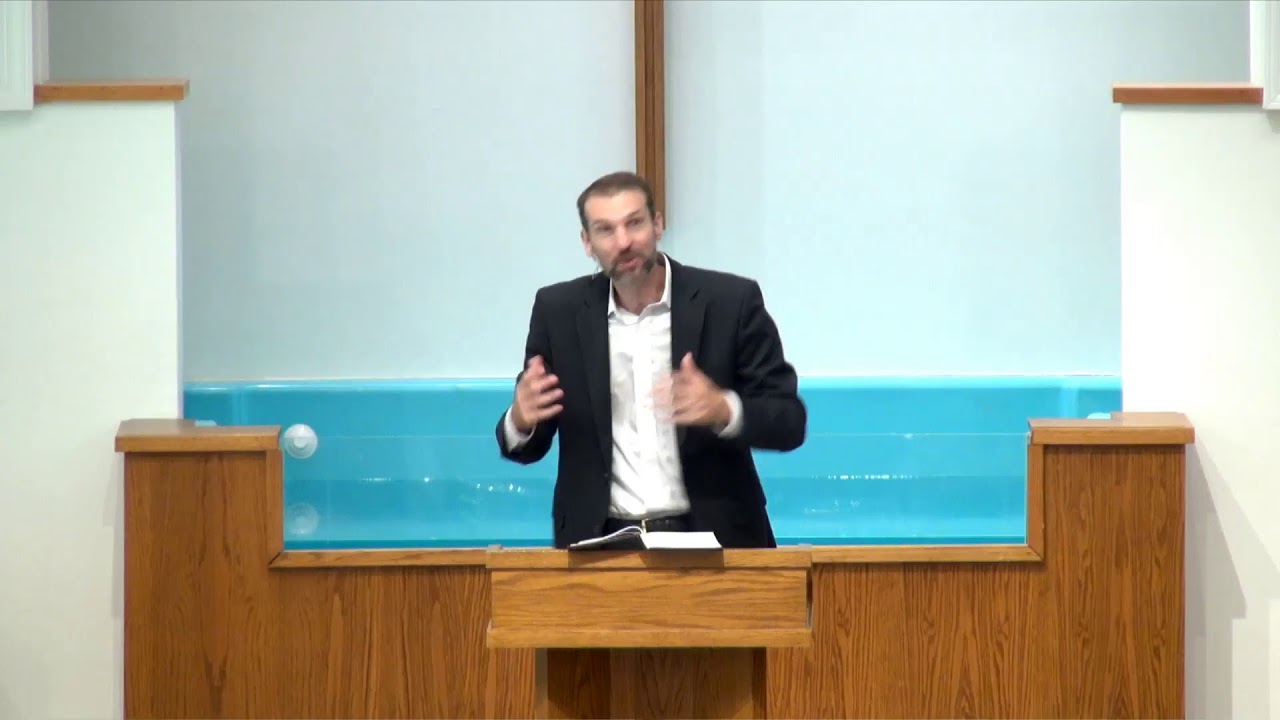
The author, in verses 9-10, is going to make the parallel with discipline from our earthly fathers, so let me think through that parallel for a second. Let’s imagine there was a couple with young children with us Sunday after Sunday, and at the end of each service their children would run along the backs of these chairs up and down the sanctuary, pick up the instruments and try to play them, dive into the baptistry every time it was full, and neither parent did anything about it. Now, let’s make some observations.
First, even though we might think, “Good grief, those children are out of control!” we would probably first think about their parents, wouldn’t we? We’d think, “Do their parents see this? Why aren’t they doing anything?” But why? Why think of parents when it’s the kids who are out of control? The answer, of course, is because we understand that God gives children parents to lovingly discipline them, and these children are showing no signs of parental discipline in their lives. Wouldn’t we be tempted to say, “Why is no one taking responsibility for their children?” Second, what if the reason the parents gave for not disciplining their children is that they love them so much that they didn’t want to bring any discomfort or affliction into their lives? Wouldn’t we tell them that by withholding discipline—however unpleasant it may be for their children—they’re actually being unloving toward their children? We might even tell these parents that their children will one day be grateful for the discipline in their lives. The child who grows up and realizes his parents didn’t discipline him doesn’t feel more loved but less loved by his parents.
Brothers and sisters, why would we think any different of our God who is an infinitely glorious and perfect loving Father to us, his children? Would we expect him to withhold from us formative, shaping discipline? He loves us too much. He is our Father. He cares too much about our good and holiness. So the next time you find yourself in the midst of trials and afflictions, one of the things you can think is that your loving heavenly Father is allowing you to walk through this not despite his love for you but because of his love for you as his child.
But even though we can use the illustration of earthly fathers with regard to our heavenly Father, there is one difference (among many) that I want to note. Earthly fathers are far from perfect in discipline, but our heavenly Father is always perfect with his. In verses 9-10 the author writes, “Besides this, we have had earthly fathers who disciplined us and we respected them. Shall we not much more be subject to the Father of spirits1 and live? For they disciplined us for a short time as it seemed best to them . . .”
It’s that last phrase I want to pick up. Our earthly fathers disciplined “as it seemed best to them,” but I promise you they didn’t do it perfectly. I know I haven’t done it perfectly. There are times we discipline more because we’re frustrated than thinking about the good of our children. There are times our laziness gets the best of us, and we don’t exercise discipline when we should. And I could go on and on with how we fail in applying or not applying discipline. But our heavenly Father is always perfect in his discipline with his children. He measures it out, having infinite wisdom in regards to our need and his plans for us. Nothing is too much or too little.
Nothing is wasted or purposeless. What a comforting reality that is! Our God disciplines us because he loves us as his children and always does it perfectly as the infinitely wise God. So, what then is his goal with discipline?
The author makes clear the goal of discipline in a few different places. Most obviously he tells us in verses 10-11 that it is for our holiness and righteousness. He writes, “He disciplines us for our good, that we may share his holiness. For the moment all discipline seems painful rather than pleasant, but later it yields the peaceful fruit of righteousness to those who have been trained by it.”
God wants us to share in his holiness and to have the peaceful fruit of righteousness in our lives, and he knows that this doesn’t come apart from painful discipline. This means that no matter whether the car is breaking down or your child is battling disease, God has purposed good for you in it, especially the growth of your holiness and righteousness.
I remember Don Carson relaying a story several years ago about a pastor who had left the ministry because of sexual immorality. He had been one of those guys that was identified as extremely gifted and seemingly quite godly at a young age, and so many latched onto him and kept putting him in positions of leadership. And eventually he fell. So Carson was taking a ride with an older pastor, when the situation of this young man had come up, and Carson asked this older pastor to give his judgment of what led to this man’s downfall. And the older pastor proceeded to tell Carson that the main danger he saw in his life is that every decision in this man’s life had been praised and every move a seeming success. And the older pastor noted that if you’re not told no or rejected or feel failure, you begin to think that you should be able to get everything you want.
I remember listening to that story and feeling like it hit me like a ton of bricks—in a good way. My response was to get on my knees and thank God right then for the painful struggles or rejection or failure he’d brought into my life. I thanked him for loving me when I didn’t want what was most loving from him. Had I been meditating on this particular text at the time I might have said, “Thank you for bringing painful discipline into my life to train me so that I might share in your holiness and yield the peaceful fruit of righteousness.” But whether I said it that way or not that day, that is indeed what God was doing in my life. And it’s what he’s done—and may be doing right now—in yours.
What then should be our response in the midst of our trying circumstances that we’re equipped because of this text to see as the gracious and painful discipline of our loving heavenly Father?
Let me start on the note that I mentioned in the first half of this point: recognizing our trials as God’s loving, fatherly discipline. There are a couple of ways that we could go wrong when the Lord brings discipline into our lives, and they are both mentioned in the quotation from Proverbs 3 that we find in verses 5-6. The author shows us two inappropriate responses to God’s discipline, writing, “My son, do not regard lightly the discipline of the Lord, nor be weary when reproved by him.”
One way we can go wrong as the Lord brings discipline into our lives is to regard it lightly. One of the ways we regard it too lightly is to ignore the Lord’s discipline and fail to consider how he may want to shape you. My guess is that all of us have been through times where the Lord is making his discipline so obvious that it couldn’t be missed. It’s the week when your fridge, oven, freezer, and dishwasher all quit working, and the repairman tells us they’re completely unrelated but just happen to all go bad at once. I remember a friend having a time like this and saying, “I would have missed the Lord’s hand if it weren’t so obvious.” And I can tell of times like that in my own life. And one way not to respond in those moments is to dismiss it, regarding it lightly. Stop and see if there’s anything the Lord may want to teach you or train you in. If you dismiss it, regarding it lightly, your loving heavenly Father may need to intensify the discipline just to make sure he’s getting your attention—just as any earthly father does if he feels his child is regarding discipline too lightly.
Another way we can respond wrongly to the Lord’s discipline is to grow weary under his discipline. In other words, we can feel crushed and unloved and want to distance ourselves from the Lord. And that’s a wrong response as well. We may have had fathers who disciplined us not only through the discipline itself but then sending the message that they wanted nothing to do with us. Brothers and sisters, that is not a reflection of God’s wisdom. As earthly fathers, we should make sure—to use the language of Scripture—that our children feel that discipline is painful rather than pleasant and that they feel loved. This is why you make sure that spanking hurts on your child’s bottom and you hold him in your arms and hug him as he cries because of that painful spanking. You’re teaching him not to regard discipline lightly, and you’re teaching him that it’s because you love him, want his good, and want to draw him toward you. And that’s what your heavenly Father wants as well. He’s drawing us toward him. So don’t grow weary and flee. Move toward him as your loving Father and learn and grow and remember his love for you.
One other way we respond rightly is by enduring in obedient faith in the midst of discipline. The first part of verse 7 reads, “It is for discipline that you have to endure.” In other words, the Lord is disciplining us for the sake of endurance. He’s exhorting us to endure with the recognition that building endurance is part of the goal of his discipline. That is, one of the reasons the Lord puts smaller forms of discipline in our lives is to build enduring, obedient faith that will be present when we face greater trials. So, instead of dismissing discipline or running away from the Lord in it, we endure and keep walking in obedient faith, looking to our Lord and knowing that he is working our good.
This is what the author tells the readers in verses 12-13, “Therefore lift your drooping hands and strengthen your week knees, and make straight paths for your feet, so that what is lame may not be put out of joint but rather healed.” It’s as if they’re lame, and the Lord is putting a weight on them in the form of this persecution. And they could grow weary and flee from Christ, but that would be like the weight crushing them and putting their knees and feet more out of joint instead of being healed. Or, they could lift their hands, strengthen their knees, stand strong, and realize that this heavy weight the Lord is putting on them is not to crush them but to strengthen them and heal them—like going through physical therapy after knee replacement surgery. It’s not pleasant, but if you avoid it, your legs will never be as strong and function as normally as they’re meant to function.
And the same is true with us. God has good intended for you. He wants to heal you, build you up, strengthen you, and build endurance in you. But you can’t dismiss his discipline or run from it if it is to have its effect. You turn toward him, endure through it, and obey in faith. And maybe you can even thank him in and through it, recognizing that this is your loving heavenly Father using every trying circumstance in your life to produce righteousness and holiness in you because he loves you and is treating you as his child. After all, if he already sent his Son to live, die, and be raised for you, why do you think he wouldn’t do everything necessary to conform you to his Son’s image for your good and his glory? Let’s then come to the table now and give him thanks. Amen.
SeriesHebrews